Quick housekeeping before we get into it: this newsletter is moving to Mondays. Same research, same teardowns, now landing at the start of your week instead of the end of it. Look for us first thing every Monday from here on. Last week I sat down with Nick Lafferty from Profound to dig into something most AI visibility conversations skip.
Everyone is measuring whether they show up. Almost nobody is measuring what gets said about them once they do.
Here’s the number that reframed it for me. Nearly half of every AI answer is unsolicited commentary the model adds on its own to sound helpful. Nobody asked for it. It didn’t come from your page.
Profound broke down what that commentary is made of:
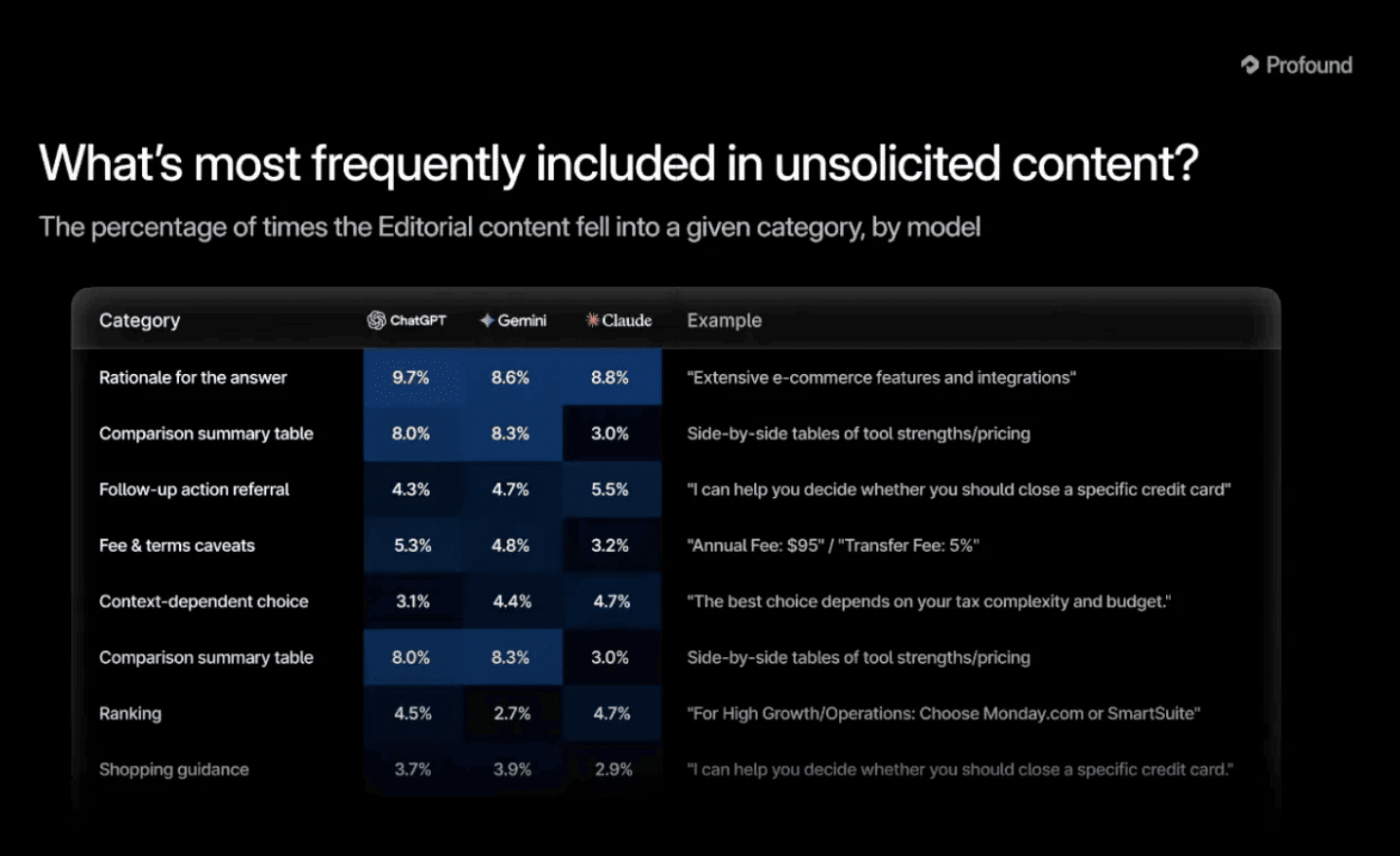
Rationale for the answer leads across every model. ChatGPT 9.7%, Gemini 8.6%, Claude 8.8%. Comparison summary tables follow at 8.0% and 8.3% on ChatGPT and Gemini. Then rankings. Then fee and terms caveats.
Read that list again. Those are the exact categories that decide a purchase.
The model is building your comparison table. Assigning your ranking. Flagging your pricing caveats. Roughly half the time, unprompted.
So the obvious next question is where that commentary comes from.
Canva is the cleanest case study I’ve seen
We published our Canva breakdown last week. 90.2 million backlinks. 434,000 referring domains. 40 million US organic visits a month. About as dominant as a brand gets.
Ask an AI whether Canva or Adobe Express is better for a small business, and it says Canva.
Then look at the citations behind that verdict. Independent reviewers. Pricing breakdown sites. YouTube comparisons. Adobe’s own comparison page. Canva contributes nothing to the answer that decides whether Canva gets picked.
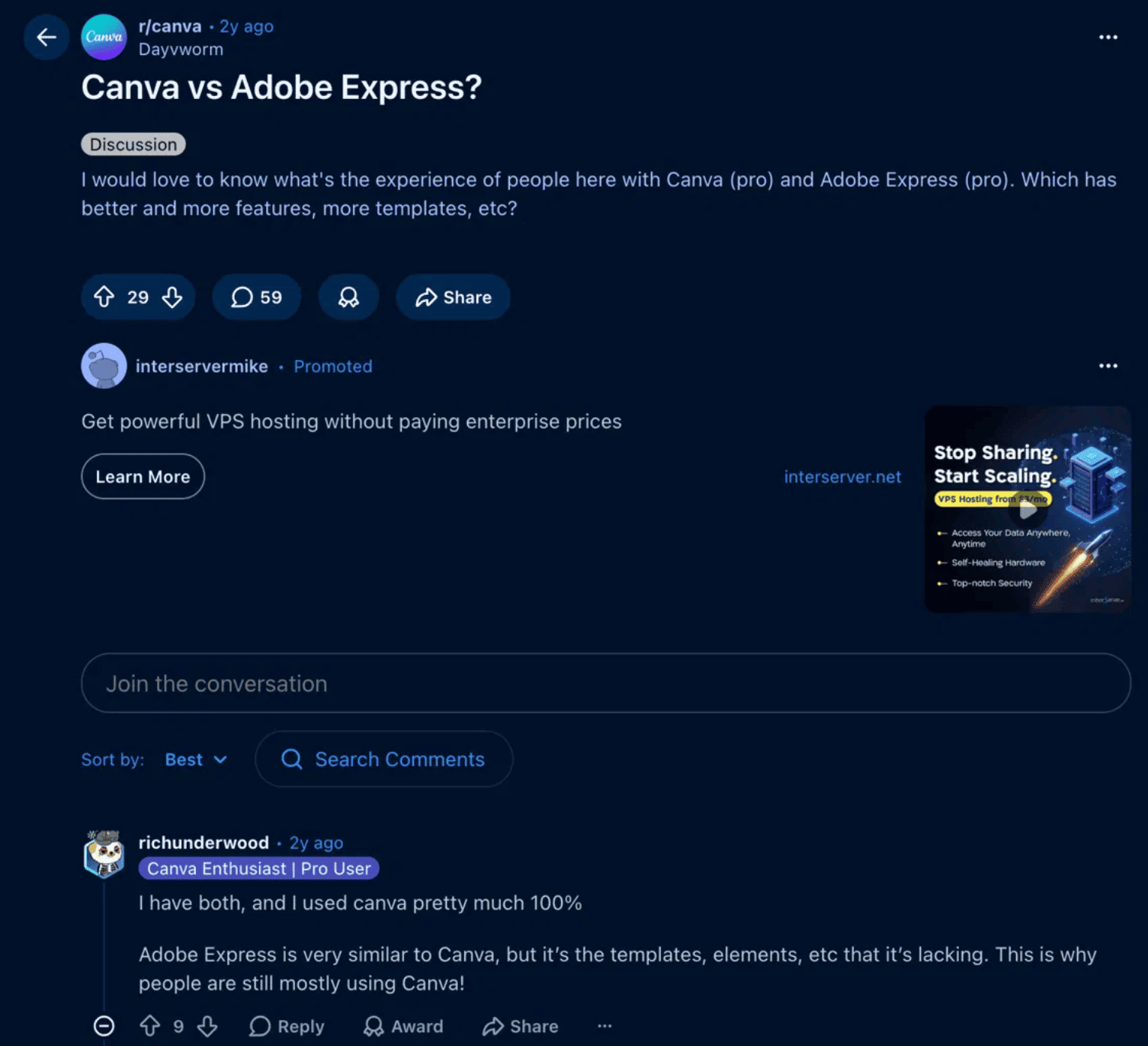
Its single strongest comparison asset arrived by accident:
A two-year-old thread in Canva’s own subreddit, ranking #2 for the decision-stage query, where a Pro user who owns both products hands Canva the win in his own words. More persuasive than anything a marketing team could publish. Entirely outside their control.
That’s the exposure. A verdict you don’t own is a verdict that gets rewritten without you.
Citations and traffic come from different surfaces
I ran a fresh pull this morning to test that.
Notion draws 5.46M organic visits a month and holds 20,093 keywords in the top three. ClickUp draws 1.77M and holds 15,676. Notion wins search by roughly 3x.
Now the citations:
→ ChatGPT: ClickUp 5,226, Notion 1,561
→ Perplexity: ClickUp 6,474, Notion 741
→ Google AI Mode: ClickUp 8,716, Notion 1,226
The mechanism is surface area. Inside AI Mode, ClickUp has 4,997 distinct pages getting cited. Notion has 893.
ClickUp’s blog ranks for 10,263 keywords and sends roughly 50,000 organic visits a month. About 3% of its organic traffic. On a dashboard that library looks like a rounding error. It’s most of the reason ClickUp is in the answer.
Four moves worth making this quarter:
- Audit what’s said, not only whether you appear. Presence tells you nothing about the rationale, the ranking, or the caveats a model attaches to your name.
- Claim investigational intent. Comparison and alternatives pages are the gap Canva left open for a decade. Most B2B brands have the same hole.
- Count your cited pages by engine. Set that number beside your top-3 keyword count. Small first number and a big second number means you’re winning a game your buyer stopped playing.
- Correct at the source. When a model answers from training data, publishing a page tomorrow doesn’t change next week’s answer. The fix has to land in the third-party sources it retrieves from.
If you want the long-form version of all four, I’m walking through them with HubSpot in a new 3-part series called Rank in the Age of AI. Everything above is the diagnosis. The series is the build. Save your seat here.
Create once. Distribute forever.
See you Monday.
— Ross
 The Data Point
 The Data Point
Ahrefs studied 75,000 brands to find what predicts AI visibility. Branded anchor text correlated at 0.527 for AI Overviews and 0.628 for Google’s AI Mode. Backlinks alone came in at 0.218. Roughly 2.4x and 3x weaker.
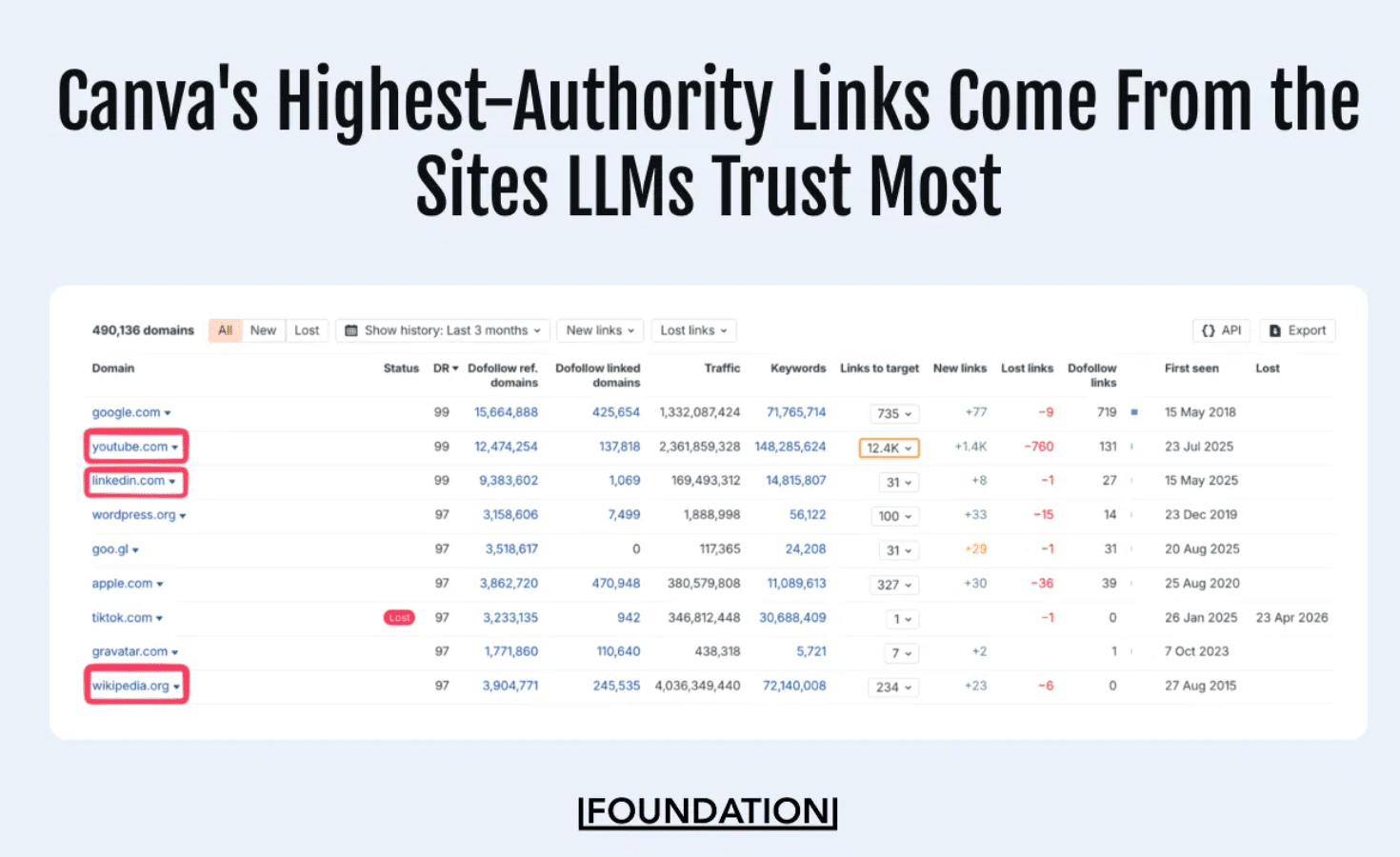
Canva’s highest-authority links come from precisely the domains the models lean on:
The language other people use next to your brand name is training the machines that describe you. Consistency there compounds for a decade.
Quick Hits
 Quick Hits
- Watch the full session with Nick. We walked through how to find inaccurate claims across engines and correct them at the source. Beyond Visibility: How to Correct What AI Search Gets Wrong
- BREAKING NEWS: August 11th -> Rank in the Age of AI, our 3-part series with HubSpot. Three sessions on earning citations when the answer replaces the click: Register for the series
- Canva’s templates section has more backlinks than its create section and three ChatGPT citations. Three. Backlinks made Canva the entity. Extractable structure earns the citation.
- 70% of Canva’s 40M monthly US organic visits are branded. Concentration around your own name looks like strength, right until a buyer asks a machine to compare you.
From the Lab
 From the Lab
- Canva Built a 90-Million-Backlink Empire. Does It Survive AI Search?
- How Vanta’s $517K/Month SEO Moat Translates Into AI Visibility
- How Atlan Turned 52 Pages Into a 35% Share of AI Citations
Want to know how visible your brand is inside LLMs? Just reply.