


Article's Content
Article's Content
YouTube was the biggest single source of AI citations on one Foundation client’s tracked prompts. It earned 6.7% of all citations, 1.7 points ahead of the next domain and more than double the client’s own site.
The client sells project management software, which had the highest YouTube citation rate of the 80 B2B software categories in our YouTube AI citation study, at 63.2%.
Tyler Wade, Senior Strategist at Foundation, spotted the pattern while researching the client’s AI visibility.
“YouTube was out-citing every website on this client’s prompts, including its own and its competitors’. We wanted to know whose videos AI was pulling from, and why.”
Tyler Wade, Strategist at Foundation
He pulled 90 days of YouTube citations from AI answers to the client’s branded and unbranded prompts. Few of the cited videos came from the client. Of the citations on videos with the client’s name in the title, 94% went to channels it doesn’t own.
Format explains much of the gap. Buyers comparing tools got pointed to reviews, comparisons, and “best” lists. We audited the YouTube channels of the client and six competitors, and six of the seven had 3.5% or fewer videos in those formats. The rest were tutorials, product news, and webinars, which serve existing customers.
The seven findings below show who earned those citations and what vendor channels can change to earn their share.
Key Takeaways
- Google AI Mode and AI Overviews produced 98% of YouTube citations in this category.
- Among the top 30 cited channels, independent reviewers held 51% of citations. Vendor channels held 23%.
- 94% of citations on videos with the vendor’s name in the title went to other channels.
- Comparisons averaged about 3.7x the citations of tutorials. “Best” lists averaged about 2.5x.
- Six of seven vendor channels we audited were 0 to 3.5% evaluative content. ClickUp, at about 10%, earned 59% of the citations across all seven.
- Tutorials drew 45% of vendor channels’ Google video traffic and 5% of AI citations.
- 27 of 216 sampled AI answers stated an outdated or incorrect fact about the vendor, mostly pricing.
How We Analyzed The Category’s YouTube Citations
We pulled 90 days of AI citation data (Jul 24 to Oct 22, 2026) from Profound for the client’s tracked prompts, across every AI model tracked. From there we:
- categorized the top 300 cited YouTube videos by title format, length and upload year
- sorted the top 30 cited channels into independent reviewers, editorial publishers and software vendors
- audited every video on seven vendor YouTube channels
- compared those channels’ Google video traffic with their AI citations
- reviewed 216 AI answers from ChatGPT, Gemini and Perplexity for accuracy and sentiment
It also covers a single category over 90 days, and 98% of the citations came from Google’s AI surfaces, so read it as directional. The prompt mix shapes the result too. Two-thirds of tracked prompts were unbranded “best X” questions, which favor lists and comparisons. A category where buyers mostly ask how-to questions could reward tutorials instead. The lesson that travels is to match the video format to the prompt type. Citations aren’t clicks or pipeline, and categories behave differently (AI citation fingerprints across B2B SaaS).
7 Findings on What AI Cited, and Who Made It
Each takeaway below starts with the result that matters most, then what it means for your own channel. Together they show who gets cited and where vendor channels fall short.
1) Google’s AI Surfaces Produced 98% of YouTube Citations
AI Mode accounted for 54.5% of YouTube citations in this category and AI Overviews for 43.9%. Perplexity added 1.2%. Gemini, Copilot, ChatGPT and Claude together made up under half a percent.

So much of “AI search” that cites YouTube still runs through Google. ChatGPT barely cites YouTube at all: 0.03% of citations here. Google owns YouTube. OpenAI owns no video platform of its own.
That leaves an open question about where OpenAI will get its video sources as it builds its own index. For a vendor, the practical read is simple. Today, YouTube is how you show up in Google’s AI answers. For ChatGPT, your site and the third-party pages it cites still do the work. Watch where OpenAI goes for video, but don’t plan around it yet.
The smaller engines behaved differently. On Gemini and Copilot, the vendor’s own channel led, with 21% and 11% of their YouTube citations. Product content does get cited there, at low volume. On Perplexity and Claude, a single creator comparison took most of the citations. Engine shares depend on which prompts are tracked, so read these as directional.
2) Independent Reviewers Earned 51% of Top-Channel YouTube Citations
Among the top 30 YouTube channels cited in AI answers to project management prompts, independent reviewers held 51% of citations. Software vendors held 23%, and editorial publishers held 19%.
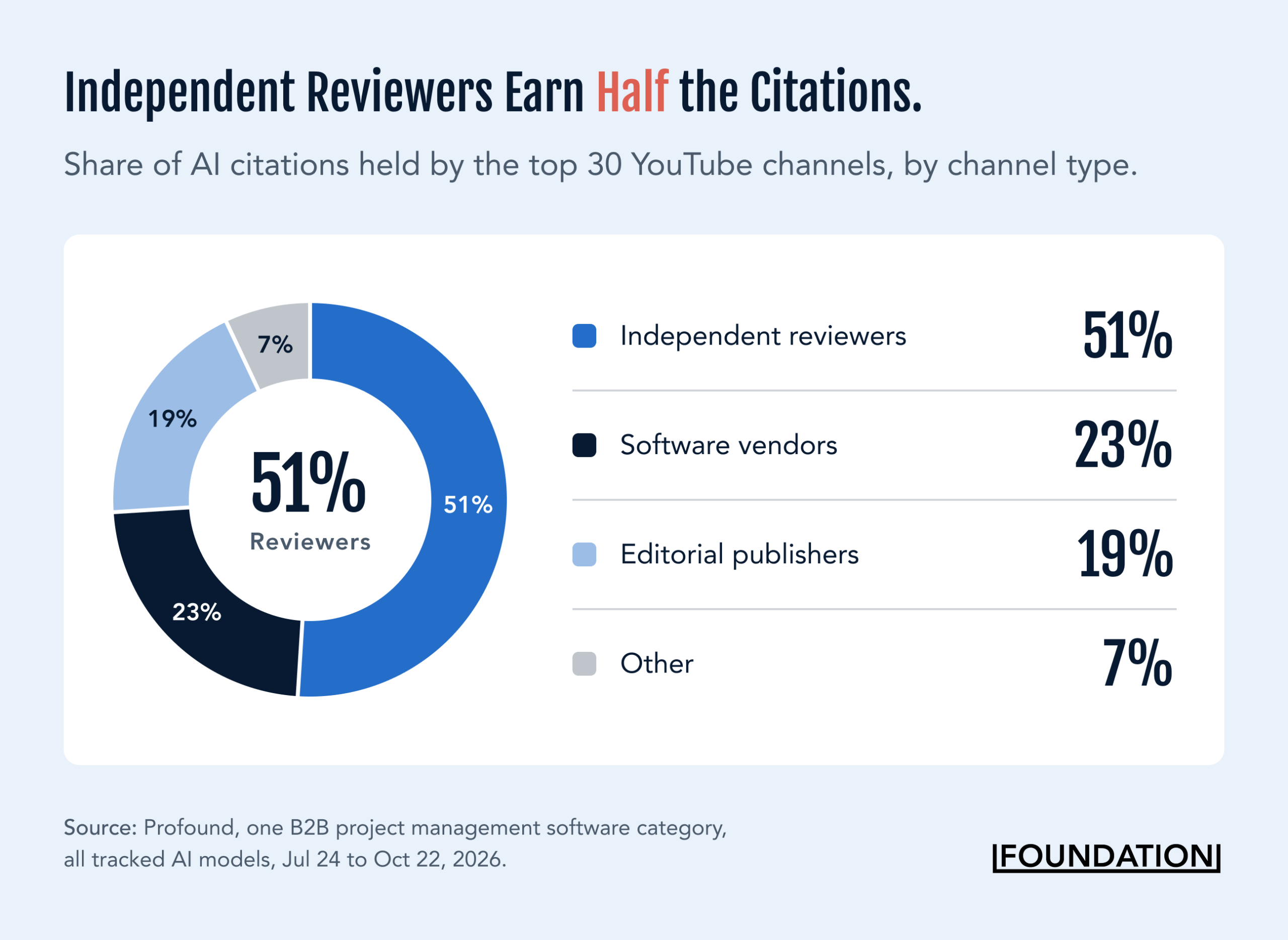
Here’s how we sorted them:
- Independent reviewers: Creators who test and compare software on their own channels, such as Speak About Digital, Jake’s Tech Lab and SoftwareFinds.
- Editorial publishers: Media and review sites that run a YouTube channel next to their articles, such as The Digital Project Manager.
- Software vendors: Companies’ own channels, such as ClickUp, Businessmap, and Jibble.
A handful of channels did most of the work. The top 10 held 47% of all YouTube citations in the category. The Digital Project Manager led with 9.6%, followed by Speak About Digital at 8.1%. ClickUp was the highest-ranked vendor, tied with Jake’s Tech Lab at 5.3%. The vendor we analyzed ranked 10th with 2.1%.
The lesson for any brand: the content you compete with in AI answers goes well beyond rival vendors’. For this client’s prompts, most of it came from independent reviewers and publishers. Before you plan your next video, pull the 10 channels cited most for your own prompts. That’s your real competitive set on YouTube.
3) 94% of Citations on Videos Naming the Client Went to Other Channels
Having your name in a video title doesn’t mean you get cited. In project management, 94% of citations on videos with the vendor’s name in the title went to other channels. Six of the 10 most-cited videos in the whole category named the vendor. None sat on their own channel.
Google showed the same pattern. Third-party videos held the video slots for the vendor’s “review”, “vs” and “tutorial” searches.
Old videos keep their place, too. Twenty third-party videos about the vendor dated from 2024 or earlier and were still being cited. One comparison from 2023 still ranked ninth in the category.
The result: a creator frames your product for the buyer before you do, sometimes with last year’s pricing.
Try this today. Search “[your brand] review” and “[your brand] vs [top competitor]” on YouTube and in Google AI Mode. If the videos that come up are third-party or more than a year old, that’s your first video brief.
4) Comparisons Earned 3.7x the Citations of Tutorials
Evaluative formats won. Comparisons averaged about 3.7 times the citations of tutorials. “Best” and “top” lists averaged about 2.5 times, and they showed up in 63% of citations across the top 300 videos.
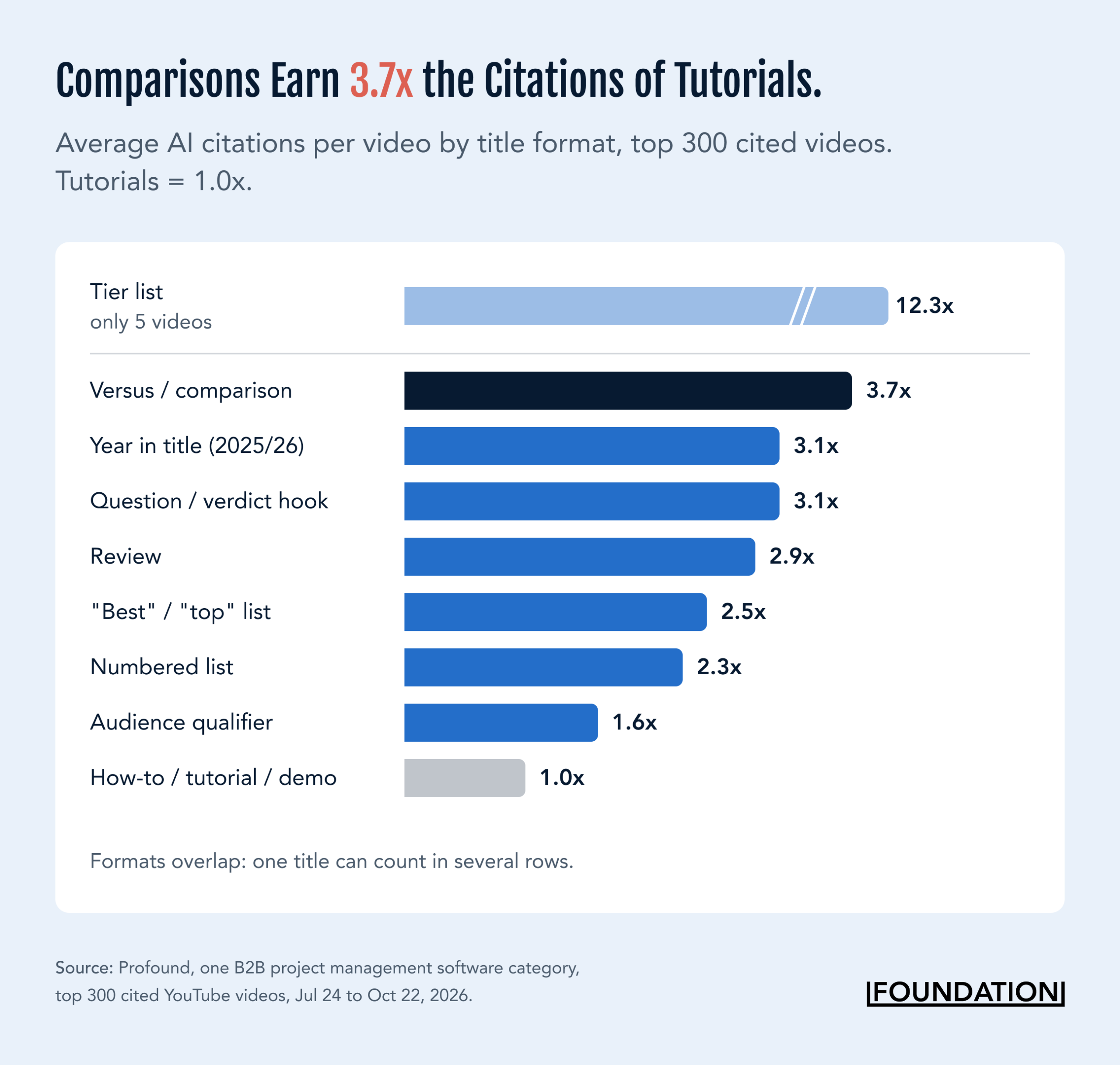
Tier lists had the highest average of any format, but only five videos used it. Treat that as a lead to test.
Length and recency ranges matched the findings from our YouTube citation study: videos of 4 to 12 minutes earned 70% of citations, and videos from 2025 or 2026 earned 81%. Shorts earned 1.4% (why Shorts rarely matter in B2B search).
If your channel leans on demos and walkthroughs, that’s worth knowing. For buying questions in this category, tutorials averaged fewer citations than any other format.
5) Six of Seven Vendor Channels Made Almost No Comparison Videos
Six of the seven vendor channels we audited weren’t publishing the type of content AI cites. We categorized every video on seven vendor channels and measured how much of each is “best” lists, comparisons, or reviews.

ClickUp sits at 9.8%. Every other channel is at 3.5% or lower, and the rest of each library is tutorials, product news and webinars. Even the vendor we analyzed uses its comparisons for methodologies, such as agile vs waterfall. None of its videos compare products.
What ClickUp Does Differently
ClickUp has 69 “best” lists and 14 comparisons on its channel, most with the year in the title. Eight of its 10 most-cited videos are “best” lists, and none are tutorials. Its most-cited video is “ClickUp vs. Asana vs. Monday: 10 Best AI Project Management Tools Compared! (2025)”.
You won’t find these videos featured on ClickUp’s YouTube home page. Buyers don’t come across them by browsing the channel. They meet them in AI answers to comparison searches. That turns bottom-of-funnel videos into discovery assets, the first place a buyer sees the product while building a shortlist.
ClickUp’s channel earned 59% of the citations across the seven vendor channels we audited, even though lists and comparisons make up only about 10% of it. Its tutorial playlists, such as Admin Essentials, likely serve onboarding and retention while the lists do the AI visibility work. That split is our read of the data.
Is It the Brand or the Format?
Ask Google why reviewers get cited over vendors, and it points to trust: independent sources look less biased. This data points more to format.
The vendor we analyzed averaged 147 citations per cited video, compared to 169 for ClickUp. Between these two vendors, brand explains little. The number of evaluative videos explains most of the difference. ClickUp has 86 lists, comparisons and reviews. The vendor we analyzed has 13, and none of them compare products. monday.com, Atlassian, Smartsheet and Asana averaged 22 to 24 citations per video, mostly from tutorials.
“I expected the gap to be about trust, with buyers favouring independent reviewers over vendors. It’s true to some extent. Most vendor channels are tutorial libraries. Tutorials are useful, but they serve customers, not buyers. When someone asks AI which tool to pick, the answer cites a comparison, and the vendor usually hasn’t made one. ClickUp did. They made the videos AI cites. Our client had optimized for SEO, but GEO told a different story.”
Tyler Wade, Strategist at Foundation
Put takeaways 2 to 4 together and one pattern shows. Creators owned the videos about this client, and the formats AI cited most were the ones vendors rarely made. Trust plays a part, as Tyler expected. Format plays a bigger one: buyers asking AI which tool to pick get pointed to comparisons, and six of the seven vendor channels were built for customers who had already picked.
It also explains why the client’s SEO numbers looked healthy. Its tutorials ranked and drew traffic, but they didn’t show up when AI answered buying questions. The next takeaway shows how wide that gap is.
6) Tutorials Drove 45% of Google Video Traffic and 5% of AI Citations
Standard video SEO numbers point the opposite way from AI citations. Across seven vendor channels, tutorials drew 45% of Google video traffic and 5% of AI citations. “Best” lists drew 7% of the traffic and 53% of the citations.

The channel totals tell the same story. Atlassian and Asana held 46% of vendor Google video traffic and 7% of vendor citations. ClickUp held 15% of the traffic and 59% of the citations. None of the 12 highest-traffic Google videos from the vendor we analyzed made the top 300 cited.
Rankings and citations do line up on evaluative searches. Of the 21 YouTube videos Google showed for “vs” and “review” queries, 12 were also in the top 300 cited. Search volume predicted little. The videos for one 200-search “vs” query held about as many citations as those for a 4,000-search head term.
For AI visibility, track citations and Google video rankings on evaluative queries. Channel views and total video traffic mostly measure your tutorials, which still earn their keep in onboarding and retention. For more on how YouTube competes in Google, see our B2B YouTube data and our guide to YouTube SEO.
This part of the data is directional. It covers seven vendor channels and a small set of queries.
7) 1 in 8 Sampled AI Answers Got the Client’s Facts Wrong
In a sample of 216 answers from ChatGPT, Gemini and Perplexity, 27 stated an outdated or incorrect fact about the vendor. Most of the errors were about pricing and which plan includes which feature.
Head-to-head answers repeated the same objections. The vendor came out ahead of Smartsheet and monday.com and behind ClickUp, with mixed sentiment in 40 of the 42 answers that compared it with ClickUp.
Here’s what those 42 answers held against it, and how a comparison page or video could answer each one:
| Objection in AI answers | Answers raising it (of 42) | What answers it |
|---|---|---|
| Higher price than the rival | 28 | What you pay on each plan, current prices side by side |
| Advanced features locked to higher tiers | 14 | Which plan includes what |
| Less customizable | 12 | Customization examples on screen |
| Steep learning curve | 8 | Getting a team running in a day |
Fix it in two places:
- ChatGPT, Gemini and Perplexity, the engines in this sample, rarely cite YouTube, so keep current pricing and plan details on your own pricing and comparison pages.
- For Google AI Mode and AI Overviews, where video does get cited, publish a dated comparison video with pricing on screen and a chapter for each recurring objection.
The bigger gap is unbranded. Two-thirds of tracked prompts were “best X” questions that name no vendor. The vendor appeared in 34 of 93 sampled answers to those and was never the top pick.
How Should a B2B Software Vendor Plan YouTube for AI Search?
Start with the 12-step playbook in our YouTube citation study. For a vendor channel, add these:
- Audit who owns your category’s cited videos, and the videos about your brand, before you plan anything.
- Publish your own “[brand] review” and “[brand] vs [competitor]” videos with the current year in the title, before creators define you.
- Turn your existing comparison and “best of” pages into 4 to 12 minute videos.
- Rank competitors fairly. A list where you win every category reads as an ad. ClickUp’s most-cited videos name and rank its rivals.
- Give a spoken verdict by use case early in the video. Name chapters in the words buyers use in their prompts (Google’s guidance on key moments).
- Add a chapter for each objection AI answers already repeat, and show dated pricing on screen.
- Give the leading independent reviewers in your category current product access.
- Refresh comparisons every year. Stale third-party videos keep getting cited until something newer replaces them.
- Report citations and Google rankings on evaluative queries (how to track AI citations) in place of channel views.
For execution, see our guide to optimizing your YouTube channel for AI visibility. For a full rollout, Ross Simmonds lays out a 90-day YouTube plan for B2B.
Your Category’s Video Answers Are Already Being Made
In this category, reviewers hold most of the YouTube citations and vendor channels mostly publish what AI skips. Video SEO numbers hide the gap. One vendor shows a channel can earn its share when it publishes the comparisons buyers ask AI for.
See who owns the video answers in your category with a free YouTube AI visibility audit. Or see how we help B2B brands get found and cited through B2B YouTube marketing.

